Ask most people how bright a light is and they will answer in watts or lumens. It is the number on the box, the spec on the cut sheet, the figure everyone reaches for. But lumens measure quantity, not quality. They tell you how much light a source produces, and almost nothing about how that light will feel in a room. Two fixtures with identical lumen output can produce completely different experiences: one harsh and glaring, the other soft and calm.
The difference is diffusion. And it is the single most underappreciated variable in lighting design.
The problem with a point source
Most light sources are, in effect, points. An LED chip, a filament, a small bright element radiating light outward. Look directly at one and it is uncomfortable. It produces glare, casts hard-edged shadows, and creates hotspots, those bright concentrated patches that draw the eye and flatten everything around them. A bare point source is efficient at making lumens and terrible at making atmosphere.
a point source creates
flatten the room
faces and objects
This is why so much effort in lighting design goes into hiding the source. Shades, baffles, lenses, coves, and louvers all exist to solve the same problem: a raw light source is unpleasant to look at, so the designer works to soften it or conceal it. The quality of a lit room is largely determined by how successfully the point source has been turned into something softer.
What diffusion actually does
Diffusion is the process of scattering light so that it no longer appears to come from a single hard point. A well-diffused source spreads its output across a broad, even surface, so the light arrives from everywhere at once rather than from one intense spot. The glare disappears. The hotspots even out. The shadows soften from hard edges into gentle gradients. The same number of lumens, delivered through diffusion, produces a completely different and far more pleasant quality of light.
The best-diffused light has a specific visual signature. You cannot easily tell where it comes from. It has no bright point to look at. It fills a space evenly, wraps around objects instead of casting hard shadows behind them, and flatters faces rather than exposing them. This is the quality that people describe as calming, warm, or soft, even when they cannot name what produces it.
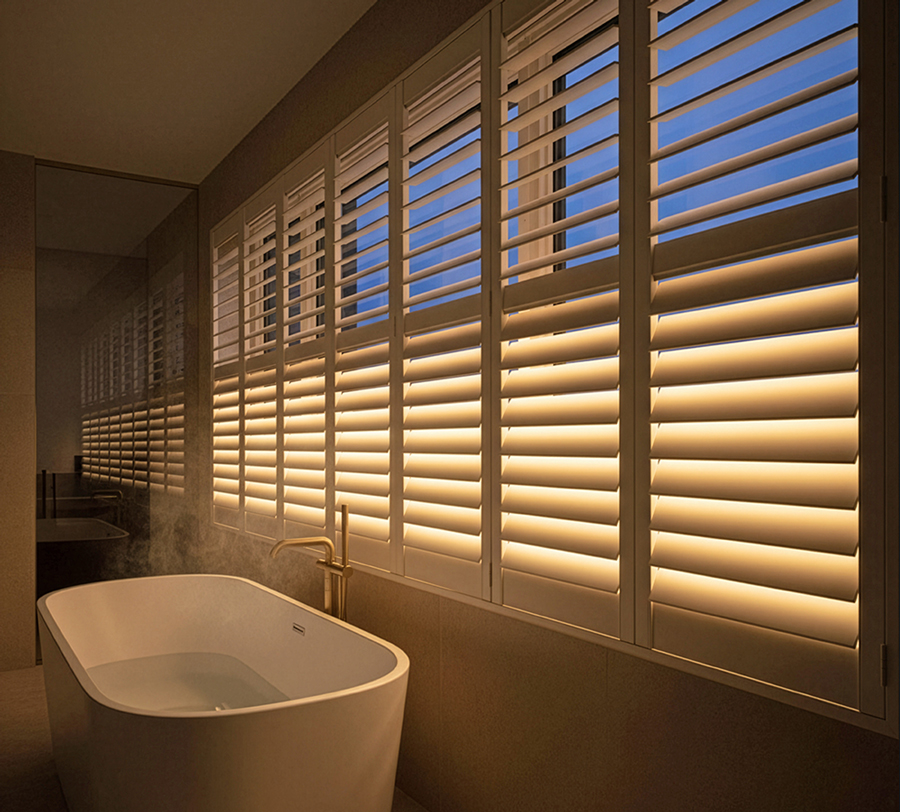
How LiteLüvr diffuses light
LiteLüvr was engineered specifically to solve the point-source problem. Rather than a single bright element, the light is generated along each louver and passed through a dedicated diffusion process before it ever reaches the room. The result is what we call super diffusion: an output so even that the light appears to emanate from the entire surface of the shutter rather than from any identifiable source within it.
Distributed generation
Instead of one bright point, light is produced along the length of each louver. The source is spread out from the start, which means there is no single hotspot to soften later.
Dedicated diffusion
The output passes through a diffusion layer that scatters the light evenly across the louver surface. The hard character of the LED is broken up before the light enters the room.
Even emission
What reaches the room is a soft, uniform glow across the whole shutter. No bright point to look at, no glare, no hotspot. The window becomes an evenly lit surface rather than a light fixture.
Why this matters for specification
When you specify a light by lumens alone, you are choosing quantity and leaving quality to chance. Super diffusion means the quality is engineered in from the start. You are not buying a bright source that you then have to soften with shades and baffles. You are buying light that is already soft, already even, already free of glare. The quality decision has been made for you.
Quality versus quantity, side by side
For designers evaluating light on more than just output, the distinction looks like this:
The metric that matters
None of this is an argument against brightness. A room needs enough light to function. But brightness is a floor, not a ceiling. Once a room has enough light, adding more lumens does not make it better. It often makes it worse, introducing glare and washing out the subtlety that makes a space feel considered. Past the point of sufficiency, quality is the only variable left that matters.
For lighting designers, this reframes the whole conversation. The question is not how many lumens a source produces. It is how the light feels when it lands: whether it glares or soothes, whether it casts hard shadows or soft ones, whether it announces its source or disappears into the atmosphere. Those are quality questions, and quality is what clients actually experience.
Super diffusion is our answer to the quality question. Not more light. Better light. Light that has already done the hard work of becoming soft before it ever reaches the room.
LiteLüvr® is a window-integrated lighting system by Radiant Blinds, LLC. To see super diffusion in person and judge the quality for yourself, request a showing.