Hospitals are built to heal, but the lighting in most of them does the opposite. Overhead fluorescent and LED fixtures run bright and cool around the clock. Patient rooms are lit for the convenience of the staff, not the recovery of the patient. And the one thing the body needs most to heal, a clear signal of day and night, is precisely the thing the environment fails to provide.
For lighting designers and healthcare architects, this is one of the most consequential gaps in the built environment. The stakes are not comfort or aesthetics. They are recovery time, medication needs, staff error rates, and the basic dignity of rest. Light is not a finishing touch in a hospital. It is part of the treatment.
The patient who cannot tell day from night
Consider what a hospital stay does to the body's internal clock. A patient is placed in a room where the light rarely changes. Bright overhead fixtures stay on for procedures and checks at all hours. There is little morning signal and little evening wind-down. Within days, the circadian rhythm that governs sleep, hormone release, and healing begins to break down.
longer hospital stays
the patient's internal clock
with poor light-dark cycles
The research on this is consistent. Patients in rooms with strong day-night light cycles tend to sleep better, report less pain, and in some studies recover faster than those in rooms with flat, constant lighting. Disrupted circadian rhythm is associated with a higher risk of delirium, particularly in intensive care and among older patients. The lighting environment is not neutral. It is either supporting recovery or working against it.
The staff side of the problem
Patients are not the only ones affected. The clinical staff who work in these environments spend long shifts, often overnight, under the same flat, cool light. Nurses and physicians working nights face their own circadian disruption, and the lighting does nothing to help them stay alert when they need to be or wind down when their shift ends.
Fatigue among healthcare staff is not a minor comfort issue. It is a patient-safety issue. Tired clinicians make more errors. A lighting environment that supports alertness during active hours and does not blast cool, activating light during quiet night hours is part of a safer, more sustainable workplace.
Why window-integrated light fits healthcare
Healthcare environments impose constraints that most lighting solutions struggle with. Every surface must be cleanable and infection-control compliant. Ceilings are crowded with mechanical, medical gas, and monitoring infrastructure. Fixtures must be durable and serviceable. And the ideal solution would support circadian rhythm without adding yet another system to an already complex ceiling.
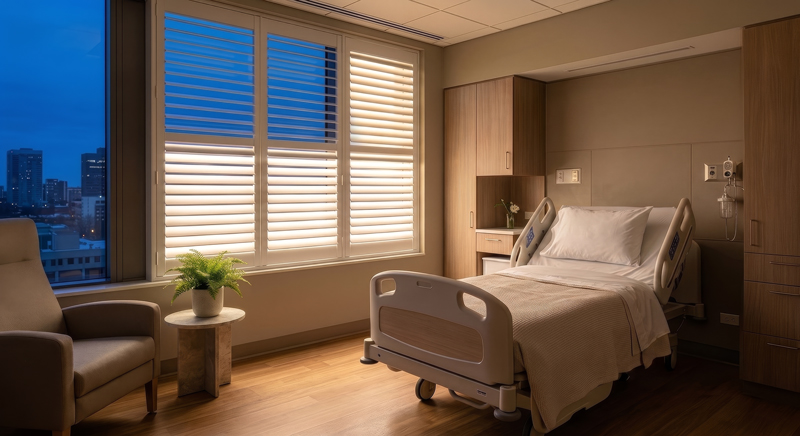
Window-integrated light addresses these constraints directly. The light originates at the window, where the room already expects daylight, so it reinforces the natural day-night signal rather than fighting it. It requires no additional ceiling infrastructure in a ceiling that has none to spare. And because the shutter is a defined, wipeable surface at the window rather than a fixture suspended over the patient, it fits the cleaning and infection-control protocols that govern these spaces.
The three-way benefit
Most healthcare design decisions involve a tradeoff between competing priorities. Window-integrated circadian light is unusual because it serves three constituencies at once. Patients get the day-night signal that supports recovery. Staff get an environment that respects their own circadian health. And facilities get a cleanable, ceiling-free solution that fits infection-control requirements. One specification, three wins.
Who benefits, and how
The case for window-integrated light in healthcare looks different depending on whose perspective you take, and it holds up from all three:
Rest that supports recovery
A gentle morning rise and evening wind-down restore the day-night signal. Better sleep, lower delirium risk, and the simple comfort of a room that feels calm rather than clinical.
Alertness and sustainability
Light that supports focus during active hours and softens at night helps clinicians manage the strain of long and overnight shifts, which is a patient-safety benefit as much as a wellness one.
Compliance and simplicity
A wipeable surface at the window instead of another fixture over the bed. No new ceiling infrastructure, and a solution that fits infection-control and maintenance protocols.
Beyond the patient room
The applications extend across the healthcare environment. Behavioral and mental health units, where calm and circadian regulation are central to treatment, benefit especially from warm, controllable, non-institutional light. Senior living and memory care settings, where circadian disruption and sundowning are daily challenges, gain a tool that reinforces the day-night cycle gently and automatically. Recovery and rehabilitation rooms, family lounges, and staff respite areas all become more humane when the light supports rest rather than resisting it.
In each of these spaces, the same principle holds. Light that arrives from the window, follows the arc of the day, and stays warm and calm in the evening does more than illuminate the room. It participates in the care.
Designing hospitals that actually heal
The phrase "healing environment" appears in nearly every healthcare design brief. But a truly healing environment has to account for the most powerful environmental signal the body responds to, which is light. A hospital that keeps its patients under flat, constant illumination is not providing a healing environment, no matter how thoughtful the rest of the design.
Window-integrated circadian light gives healthcare designers a way to close that gap without fighting the ceiling, the cleaning protocols, or the budget. It is a rare specification that serves the patient, the clinician, and the facility at the same time. And it turns the window, long treated as a simple source of daylight and view, into an active part of the care the building was built to provide.
LiteLüvr® is a window-integrated lighting system by Radiant Blinds, LLC. To discuss a healthcare application or see the circadian light cycle in person, request a showing.