There is a quiet assumption built into most lighting plans: that a well-lit room needs a lot of light sources. A layer of recessed cans for ambient. A pendant for the table. Sconces for the walls. Lamps for the corners. Cove strips for the ceiling. Each one added to solve a problem the last one left behind. The result is a room with a dozen ways to make light and no single idea holding them together.
The best-designed rooms often do the opposite. They subtract. They ask not how many sources a room can hold, but how few it actually needs. And the answer, more often than designers expect, is remarkably small.
More sources, more compromise
Every fixture added to a room brings its own set of obligations. It needs a location, which competes with the architecture. It needs power, which means wiring and a switch. It needs to be coordinated with every other fixture so the layers do not clash. And it needs to be maintained, cleaned, and eventually replaced. A room with ten light sources is not ten times better lit than a room with two. It is ten times more complicated.
typical layered scheme
anchor the whole room
the light lives at the window
Complexity is not the same as quality. In lighting, the two are often at odds. A room crowded with sources tends to produce competing pools of light, mismatched color temperatures, and a visual busyness that the eye reads as clutter even when every fixture is beautiful on its own. The more the room has to manage, the less coherent the light becomes.
The subtraction principle
Minimalist design is often misunderstood as the absence of things. It is really the presence of only the right things. In lighting, this means starting not with what to add, but with what the room actually requires, and resisting the urge to fill every gap with another fixture.
When a fixture leaves a room, the room gains something. Remove a floor lamp and a corner opens up. Remove a row of cans and the ceiling becomes whole. Remove a pendant and the sightline across the room clears. Subtraction is not loss. It is the recovery of space, surface, and calm that the fixture was quietly consuming.
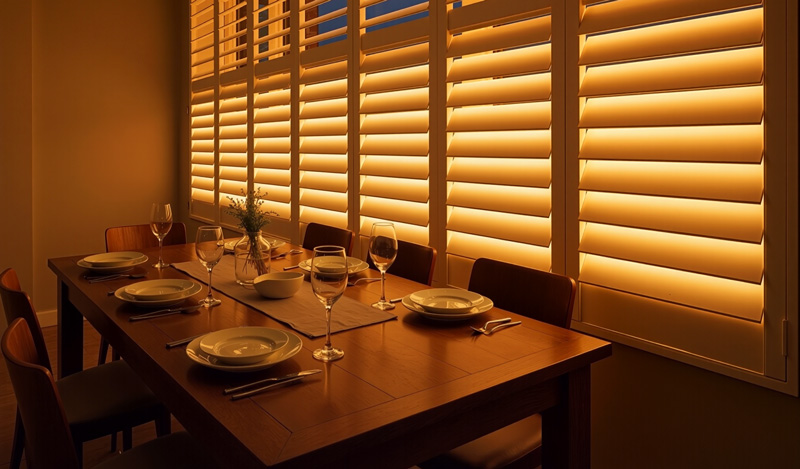
The minimalist's question
Instead of asking "what light does this room need to add," ask "what is the fewest number of sources that can light this room beautifully." The answer reframes the entire plan. When one warm, diffused ambient layer can carry the room, the decorative and accent fixtures become genuine choices rather than necessities. You add them because you want them, not because the room would be dark without them.
When one layer carries the room
The reason most rooms need so many fixtures is that the primary ambient source, usually overhead, does its job poorly. It lights the floor and the tops of surfaces while leaving the walls dim and the corners in shadow. So the designer adds lamps to fill the corners, sconces to light the walls, and cove strips to soften the ceiling. Each addition is a patch on the shortcomings of the one before.
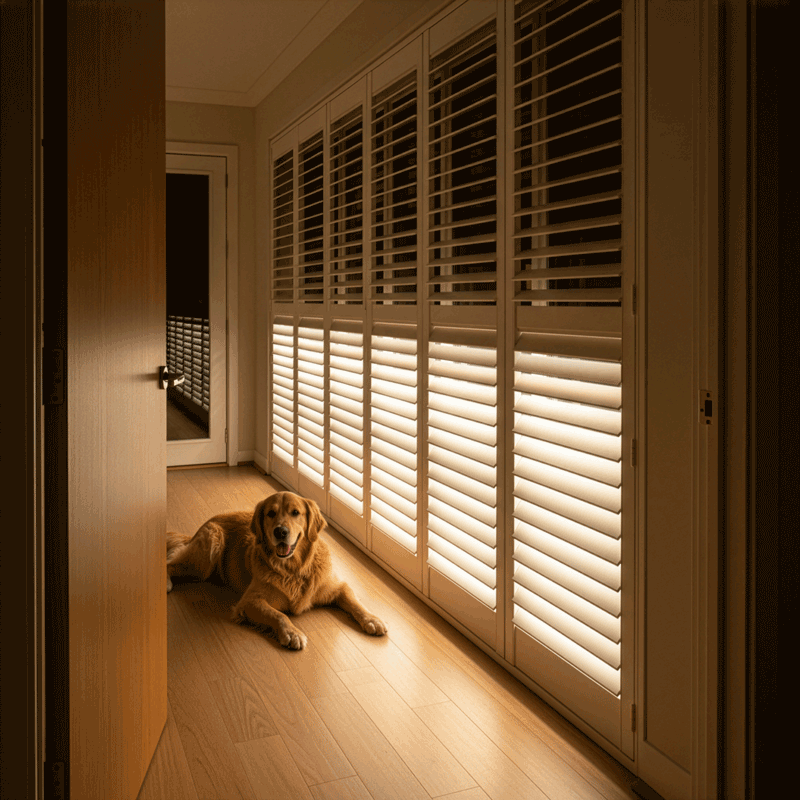
Change the primary source, and the need for patches largely disappears. When the ambient layer originates at the window and fills the room evenly from the vertical plane, the walls are lit, the corners are soft, and the shadows are gentle from the start. There is nothing left for the lamps to fix. The room is already whole.
Three moves toward less
For designers drawn to a more minimal approach, the path starts with subtraction and a stronger primary source:
Start with the ambient layer
Specify a primary source that lights the room evenly from the wall plane. When the foundation is strong, most of the supplementary fixtures become optional rather than required.
Remove before you add
For every fixture in the plan, ask what the room loses if it goes. If the answer is nothing the ambient layer cannot cover, let it go. The room gains a clean surface in return.
Keep only what earns its place
A sculptural pendant you love. A reading lamp that gets used every night. Keep the fixtures that are genuine choices. Cut the ones that exist only to compensate for weak ambient light.
The atmosphere that subtraction creates
There is a particular quality to a room that has been lit with restraint. The light feels intentional rather than accumulated. The surfaces are clear. The ceiling is quiet. Nothing competes for attention, so everything in the room, the furniture, the art, the people, reads more clearly. This is the atmosphere that fewer fixtures create. Not emptiness, but clarity.
The irony of great lighting design is that the goal is often invisibility. The best ambient light does not announce its source. It simply makes the room feel right. And the fewer sources it takes to achieve that feeling, the more completely the light disappears into the architecture, leaving only the atmosphere behind.
Fewer fixtures. More atmosphere. It is not a compromise. It is the whole point.
LiteLüvr® is a window-integrated lighting system by Radiant Blinds, LLC. To see how one ambient layer can carry a room, request a showing.