Most homes have exactly two lighting states in the evening: on and off. The lights are on while people are awake, and then, at some point before bed, someone flips a switch and the room goes dark. That transition, from full brightness to nothing in a single instant, is one of the least natural things we ask our bodies to do. The human body was made to rest as light fades gradually, not to drop from noon to midnight in the time it takes to flip a switch.
For interior designers thinking about how a home actually supports the people who live in it, the evening is where the biggest opportunity hides. Not the dramatic moments. The quiet ones. The last two hours of the day, when the body is trying to wind down and the lighting is usually working against it.

What the body is trying to do
In the hours before sleep, the body runs a carefully choreographed sequence. Core temperature begins to drop. Melatonin production ramps up. Cortisol, the alertness hormone, tapers toward its nightly low. Heart rate and blood pressure ease. The nervous system shifts from its active, sympathetic state toward the restful, parasympathetic one. This is the wind-down, and it is a gradual process that takes one to two hours when it is allowed to happen naturally.
Light is the single most powerful external signal governing this sequence. And in most homes, the light is sending the wrong message right up until the moment of darkness.
wind-down window
standard evening room light
to total darkness
The problem is twofold. First, standard evening lighting is too bright and too blue, keeping melatonin suppressed during the exact window when it should be rising. Second, the transition to darkness is instantaneous. The body gets no runway. It is running at full alertness one moment and expected to sleep the next.
A room that turns off versus a room that winds down
Consider the difference between two rooms. In the first, the evening plays out the way it does in most homes. Overhead lights burn at full brightness through dinner and the hours after. Then, at bedtime, a switch is flipped and the room goes black. The nervous system, still receiving bright bluish light seconds ago, is now expected to power down on command.
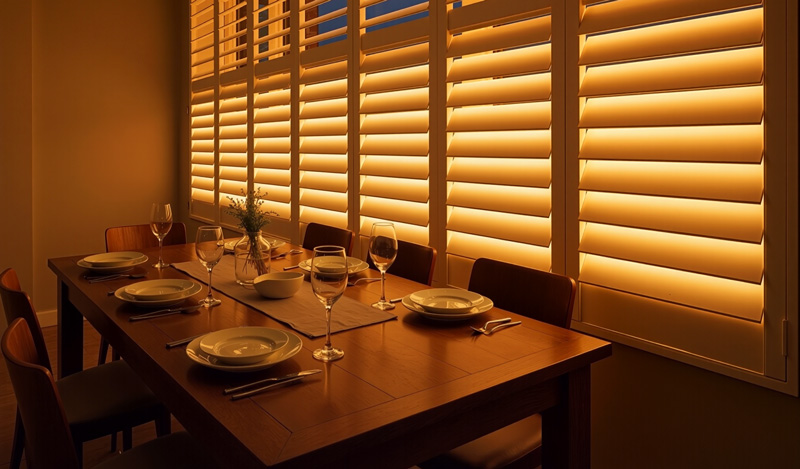
In the second room, the evening unfolds differently. As the hours pass, the ambient light gradually dims and warms. The bright neutral light of the active evening softens toward amber. By the time the occupant is ready for bed, the room is already glowing at a low, warm level that matches the body's internal state. The final transition to darkness is a small step, not a cliff.
The design distinction
A room that turns off treats lighting as a binary utility: on when needed, off when not. A room that winds down treats lighting as a gradient that follows the body's rhythm. The first is engineered for the switch. The second is designed for the person. That difference is invisible on a floor plan and unmistakable in lived experience.
The evening, hour by hour
Here is what a well-designed evening transition looks like when the lighting is built to support rest rather than resist it:
The taper begins
Ambient brightness starts to ease down from its daytime peak. The shift is slow enough that no one consciously notices, but the body registers the change and begins its wind-down sequence on schedule.
The warmth arrives
The tone shifts toward amber. Blue-spectrum light fades from the room. Melatonin production, no longer suppressed, climbs the way it is supposed to. The space feels cozier without anyone adjusting a thing.
The gentle landing
The room settles into a low, warm glow. When it is finally time for full darkness, the step is small. The nervous system has been coasting toward rest for an hour. Sleep arrives faster and deeper.
Designing the transition into the room
The challenge for designers has always been that this kind of gradual evening transition is hard to build with conventional lighting. It requires tunable fixtures, dimming controls, and scheduling, usually spread across multiple ceiling zones. Most homes do not have that infrastructure, so the evening stays binary: bright, then black.
LiteLüvr makes the transition native to the room. The sunset simulation warms the window and gradually dims the light over a programmed period, so the wind-down happens automatically. No one has to remember to dim anything. The room simply follows the evening down toward rest, and the people in it follow the light.
Schedule the sunset
Program the evening taper to begin a couple hours before the household's typical bedtime. The room transitions and warms on its own, no fiddling required.
Warm the final hour
Amber light from LiteLüvr provides all the illumination the last hour before bed so the feeling is warm and low. This is the window where melatonin recovery matters most.
Soften the last step
Let the room settle to a low glow before darkness rather than cutting from bright to black. The gentle landing is what the nervous system is waiting for.
The quiet luxury of a good evening
Clients rarely ask for better sleep in a design brief. But it is one of the most valuable things a home can give them, and lighting is one of the few design elements that can deliver it directly. A room designed for the evening wind-down does something furniture and finishes cannot. It changes how the person feels at the end of every single day.
That is the kind of detail that turns a house into a place someone never wants to leave. It does not show up in a photograph. It shows up at eleven at night, when the room is glowing warm and low, and the person in it feels, without knowing why, that it is time to rest.
LiteLüvr® is a window-integrated lighting system by Radiant Blinds, LLC. To experience the sunset simulation and evening wind-down in person, request a showing.