Almost every project has one. The window that looks out at the neighbor's siding four feet away. The bedroom window facing the parking lot. The bathroom window with a direct view of the HVAC units. The kitchen window that frames nothing but a fence. These windows are a quiet frustration for designers, because they carry all the obligations of a window with none of the rewards.
A good window earns its place. It brings in light, frames a view, and connects the room to the world outside. A poor-view window brings in light the room may not want, frames something nobody wants to look at, and connects the room to a parking lot. Yet it still has to be dressed, treated, and worked around like any other opening.
The three bad options
When designers encounter a poor-view window, they typically choose between three unsatisfying solutions. Each one manages the problem. None of them solves it.
blocks the view and the light
keeps light, kills clarity
and live with the view
Option one is to cover it. Heavy drapery or a permanent blind blocks the unappealing view, but it also blocks the light and turns the window into a dead zone on the wall. Option two is to obscure it. Frosted or textured glass keeps some daylight while hiding the view, but it produces a flat, institutional quality and forfeits any sense of connection to outside. Option three is to ignore it. Leave it bare, accept the parking lot, and hope the furniture arrangement draws the eye elsewhere.
Each of these treats the window as a liability to be minimized. What if it could be an asset instead?
Reframing the window
Here is the shift. A window has two functions that we tend to bundle together: it provides a view, and it provides light. When the view fails, we assume the window has failed. But the light function is entirely independent of the view. A window with a terrible view can still be an excellent light source. The problem is that conventional treatments force a tradeoff: to hide the bad view, you usually have to sacrifice the light.
LiteLüvr breaks that tradeoff. Because the shutter produces its own light from within the louvers, the window no longer depends on the view or even on daylight to contribute to the room. Close the louvers against the parking lot, and the window becomes a soft, glowing panel of warm ambient light. The bad view disappears. The light remains. The window earns its place after all.
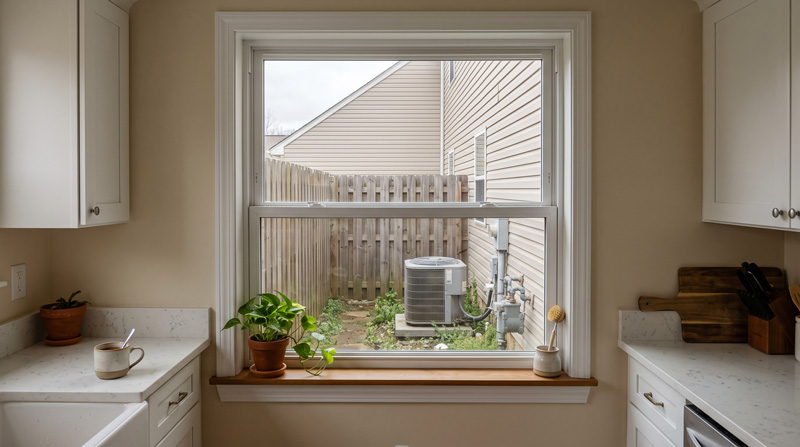
The reframe that changes the spec
Stop asking "how do I hide this view?" and start asking "what if this window were a light source instead of a view?" The moment the window's job changes from framing the outside to illuminating the inside, the poor view stops being a problem. It becomes irrelevant. The worst window in the room becomes a warm, glowing asset.
Where poor-view windows are most common
This problem shows up everywhere, but a few rooms are chronic offenders. Urban bedrooms facing an air shaft or an adjacent building. Bathrooms with privacy-required windows facing the street. Kitchens over the sink looking at a side yard or fence. Basement-level or garden-level windows with sightlines into planting beds or retaining walls. Powder rooms with a single small window facing nothing in particular.
In each of these cases, the window is currently being managed as a problem. With a self-illuminating shutter, each one becomes a source of the warm, diffused ambient light that these rooms usually lack. The bathroom gets a spa-like glow instead of a frosted view of the neighbor's downspout. The urban bedroom gets soft evening light instead of a blackout blind fighting a streetlight.
Before and after
For designers weighing how to treat a poor-view window, the difference looks like this:
Three ways to put it to work
For interior designers and architects working with difficult windows, the applications are direct:
The privacy bathroom
Replace frosted glass or a permanent blind with a shutter that closes for privacy and glows for ambiance. The room gains a spa-like warmth it never had access to before.
The urban bedroom
Close the louvers against the air shaft or the streetlight, then use the sunrise simulation for a gentle wake. The bad view is gone. The circadian benefit arrives.
The dim interior room
For windows that face a wall or narrow gap and never get real daylight, the self-produced light fills the gap. The room reads bright even when the exterior offers nothing.
The opportunity hiding in plain sight
Designers spend a lot of energy minimizing poor-view windows. Draping them, frosting them, arranging rooms to steer the eye away from them. That energy is spent managing a liability. The reframe is simple but powerful: the window was never going to give you a view, so stop asking it for one. Ask it for light instead.
The parking-lot window becomes a warm evening glow. The air-shaft window becomes a sunrise. The frosted bathroom window becomes a spa. The worst window in the project becomes one of the most pleasant surfaces in the room. That is not damage control. That is design.
LiteLüvr® is a window-integrated lighting system by Radiant Blinds, LLC. To see how a closed shutter becomes a light source, request a showing.