Circadian lighting has arrived in the specification conversation. It's in the wellness briefs, the WELL Building criteria, the hospitality RFPs. The science is no longer debatable — light exposure patterns shape sleep quality, hormone regulation, and daily cognitive performance in ways that are measurable and significant. And yet, in most residential lighting plans, circadian support is still absent.
The reason isn't awareness. It's infrastructure. Delivering circadian-appropriate light — light that changes in intensity and warmth across the day — usually means adding another layer to an already crowded ceiling. More fixtures, more control zones, more wiring. For most residential projects, that's where the conversation ends.
The daily arc
The body's circadian system doesn't respond to a single light level. It responds to a pattern — a daily arc that begins with cool, bright light in the morning, shifts to neutral during midday, warms and dims through the evening, and approaches darkness at night. Every phase matters, and the transitions between them matter most.
Dawn Rise
Gradual brightening from warm to neutral. Suppresses melatonin, initiates cortisol. The body wakes slowly.
Active Day
Full brightness, neutral-to-cool tone. Supports alertness, focus, and energy through peak hours.
Evening Dim
Brightness decreases, tone warms toward amber. The nervous system begins its wind-down. Rest becomes possible.
Night Rest
Minimal light, deep warm tone or darkness. Melatonin production peaks. Sleep quality depends on this phase.
Here's the specification problem: delivering this arc with conventional ceiling fixtures requires tunable-white LED downlights, zoned dimming, a programmable control system, and dedicated wiring for each zone. In a residential bedroom, that means adding four to six ceiling fixtures with tunable drivers plus a control interface — just to support the circadian layer. On top of task lighting, accent lighting, and whatever decorative fixtures the interior designer has already specified.
for ceiling-based circadian
poor sleep quality
for optimal melatonin suppression
The ceiling is already full
This is the practical reality lighting designers face. By the time the ambient layer, task fixtures, and accent lighting are laid out, the ceiling is a coordination exercise. Adding a dedicated circadian layer means more penetrations, more drivers, more control zones, and more conversations with the electrician and the GC. In a luxury residential project with a $15,000 lighting budget per room, it's possible. In a standard residential project, it's the first thing cut from the scope.
The result is that circadian lighting remains a premium feature rather than a standard practice — not because the science is lacking, but because the delivery mechanism is too complex for most projects.
The specification gap
Circadian lighting is well understood, widely recommended, and rarely delivered — because the conventional path requires dedicated ceiling infrastructure. The gap isn't knowledge. It's implementation. Designers know what the body needs. They just don't have a clean way to deliver it within a typical residential scope.
A different delivery mechanism
LiteLüvr approaches this problem from the opposite direction. Instead of adding fixtures to the ceiling, the circadian layer originates from the window — where natural light already enters during the day. The sunrise and sunset simulation built into the LiteLüvr app allows each panel to follow a programmed daily arc: gradually brightening at dawn, maintaining a consistent ambient level through the day, warming and dimming through the evening, and fading to darkness at night.
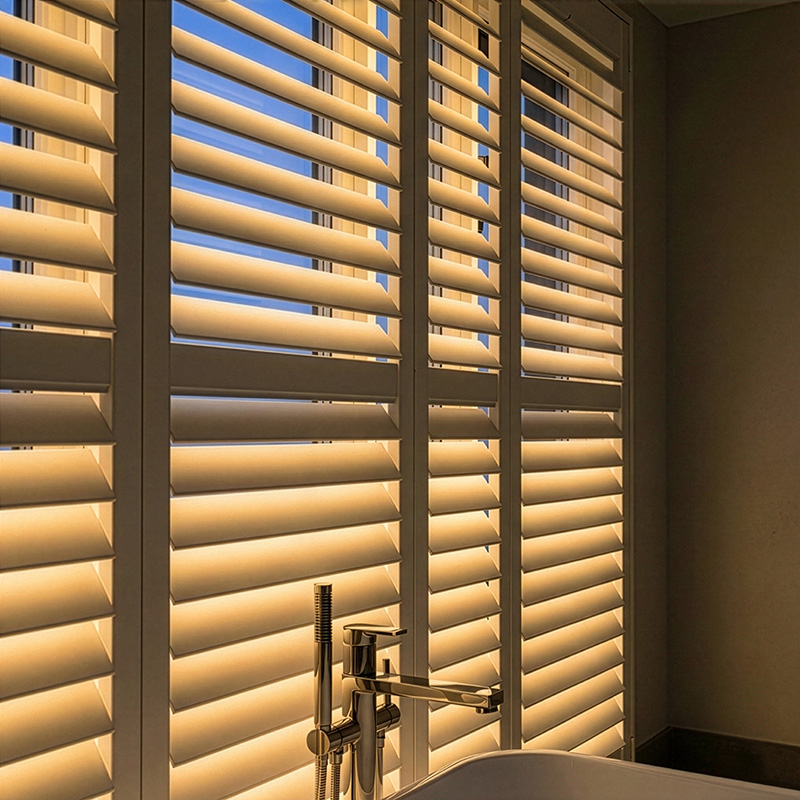
No tunable downlights. No additional ceiling penetrations. No separate control system. The circadian layer is built into the window covering, controlled by app or scheduled routine, and completely independent of whatever else is happening on the ceiling plan.
For the lighting designer, this means the circadian conversation becomes a specification note rather than a scope expansion. LiteLüvr handles the ambient rhythm while the ceiling plan handles task, accent, and decorative layers — each doing what it does best, without competing for the same real estate overhead.
What this means for your wellness-oriented projects
If you're designing for a client who has mentioned sleep, wellness, or circadian rhythm — and increasingly, they all do — you now have a path that doesn't require expanding the electrical scope. The rhythm lives at the window. The ceiling stays clean. The budget stays intact.
Specify the sunrise simulation for the bedroom. Schedule the evening dim for the living areas. Let the daily arc happen at the architectural plane where natural light was already expected — and free the rest of the scheme to focus on what overhead lighting does best: task visibility, accent drama, and decorative impact.
Circadian lighting shouldn't be a luxury upgrade. It should be a default layer in every residential plan. The obstacle has always been delivery. The window removes it.
LiteLüvr® is a window-integrated lighting system by Radiant Blinds, LLC. To see the sunrise simulation and daily arc in a real residential setting, request a showing.