There is a quiet shift happening in lighting design. Not a trend — trends reverse. This is more like a correction. After decades of placing the primary ambient source on the ceiling, a growing number of lighting designers are asking a different question: what if the room's ambient light came from the wall plane instead?
The answer, it turns out, has been well understood in commercial and museum design for years. What's new is the conversation happening in residential and hospitality — where the ceiling has gone largely unchallenged as the default origin of light.
The ceiling got there first. That doesn't mean it belongs there.
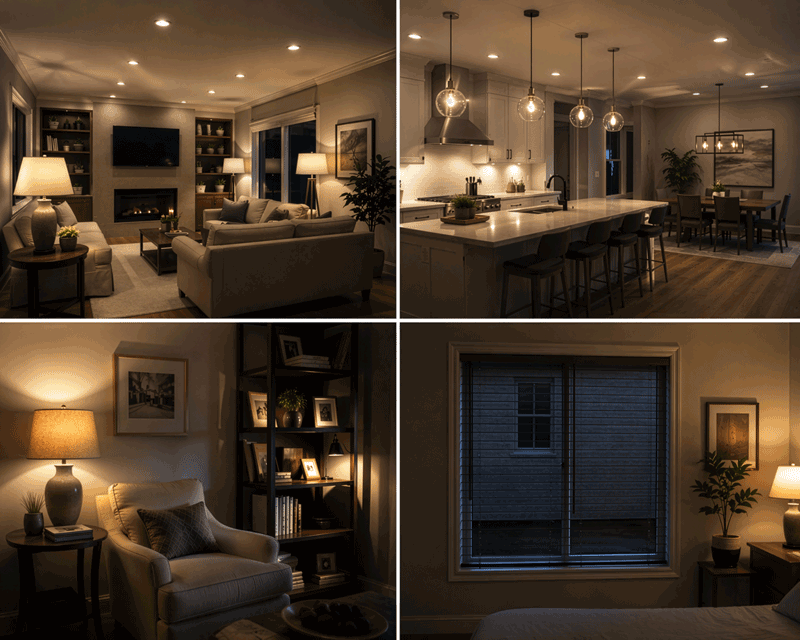
Recessed downlights became the dominant residential lighting solution for a practical reason: ceilings are easy to access, easy to wire, and easy to lay out on a grid. A standard 12×12 room with an 8-foot ceiling typically receives six to eight recessed cans spaced roughly four feet apart. Multiply that across a full-home plan and you're looking at dozens of ceiling penetrations — each one projecting light straight down onto horizontal surfaces.
The result is functional. The result is also, from a design perspective, predictable: hard shadows under faces, flat illumination on vertical surfaces, and a quality of light that reads more like an office than a home.
The science of vertical illumination
Here's the part that changes the conversation for lighting designers. The human visual system doesn't weight all surfaces equally. Research in lighting ergonomics consistently shows that roughly 80% of daily visual information enters the eye from the horizontal field of view — meaning we spend most of our time looking at walls, not floors or ceilings.
from horizontal view
walls vs. floors at equal lux
in a typical 12×12 room
When vertical surfaces are illuminated uniformly, the room reads as dramatically brighter — even at the same measured illuminance. Lighting research from ERCO and the Illuminating Engineering Society has demonstrated that illuminating walls instead of floors at 100 lux produces a perceived brightness increase of three to five times. The room doesn't have more light. It has better-placed light.
This isn't a marginal improvement. It's a fundamental reorientation of where light does its most effective work. And for designers, it raises an uncomfortable question: if vertical illumination is measurably more effective at creating brightness, spatial expansion, and visual comfort, why are most residential schemes still ceiling-first?
What ceiling dependency actually costs
The answer is infrastructure. Wall washing has traditionally required dedicated fixtures — recessed asymmetric downlights, linear slots, or surface-mounted wall washers — each adding to the fixture count, the wiring complexity, and the ceiling clutter that the technique is supposed to reduce. You solve one problem and create another.
This is the paradox that has kept vertical-plane illumination mostly confined to galleries, lobbies, and high-end retail: the tools to deliver it still live on the ceiling.
The designer's paradox
To move light off the ceiling, you traditionally need more fixtures on the ceiling. Wall washers, asymmetric downlights, and linear slots all require ceiling access, wiring, and housing. The ambient layer you're trying to create from the wall plane still originates from above — and brings all the coordination, cost, and penetrations that come with it.
A different origin
This is where the conversation shifts from technique to technology. What if vertical-plane illumination didn't require a ceiling fixture at all? What if the ambient layer originated from the wall plane itself — from inside the architecture, not projected onto it?
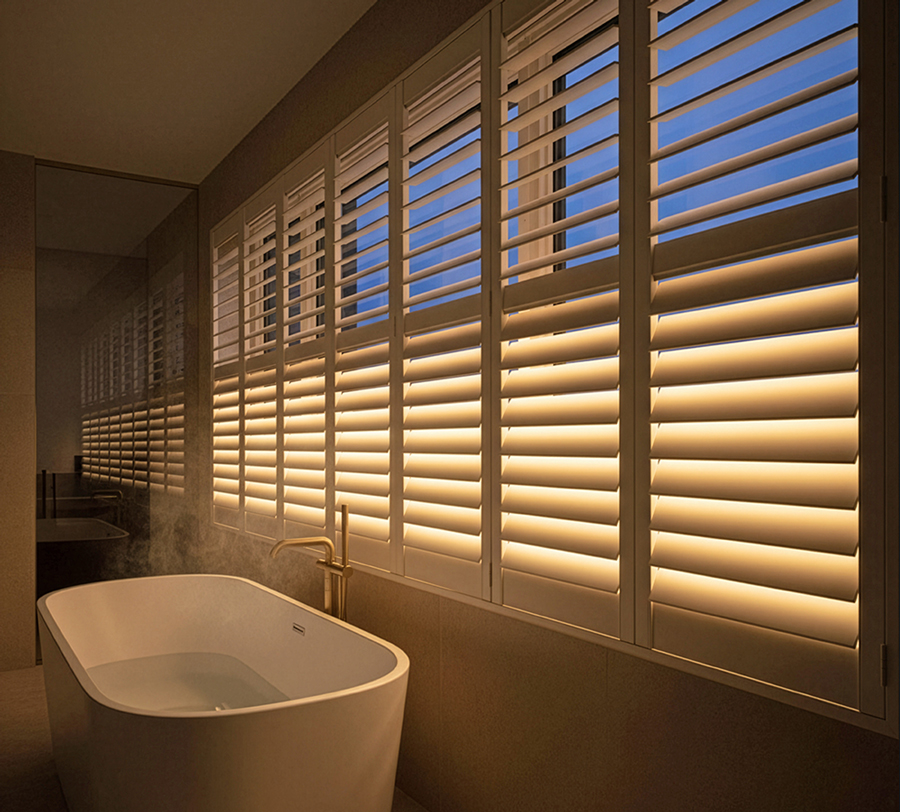
LiteLüvr was designed around this exact principle. By integrating LED arrays into each 3.5-inch louver and diffusing the output through a dedicated layer, the window shutter becomes a primary source of soft, uniform, vertical-plane illumination. No ceiling fixture required. No wall-washer spacing calculations. No additional penetrations.
The light originates at the wall plane, distributes evenly from ceiling to floor, and produces the same spatial expansion and brightness impression that wall washing achieves — without any of the infrastructure that ceiling-mounted wall washers demand.
The before and after
For designers evaluating the vertical light plane as a design move, here's what changes in the specification:
What this means for your next lighting plan
If you're a lighting designer, the vertical light plane isn't a replacement for your existing layers — it's a genuinely new one. Accent, task, and decorative layers still do their work. What changes is the ambient foundation. Instead of building it from the ceiling down, you build it from the wall plane out. The result is a calmer, more diffused field that lets every other layer in the scheme do its job more clearly.
If you're an interior designer, this is the move that simplifies the ceiling. Fewer cans. Fewer penetrations. Fewer compromises with the architecture above. The ambient layer is handled at the window, and the ceiling becomes what it arguably should have been all along — clean, quiet, and architecturally uninterrupted.
The vertical light plane has always been the more effective surface to illuminate. What's changed is that there's now a way to do it without adding complexity above. The light moves to where it's always belonged — into the room itself.
LiteLüvr® is a window-integrated lighting system by Radiant Blinds, LLC. To see how vertical-plane illumination performs in a real residential setting, request a showing.